|
|
Press Release
Part
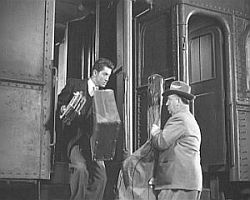
way through the 1951 Hitchcock film 'Strangers on a Train' there is a
scene in which a portly middle-aged man in a suit and hat can be seen
clambering aboard a steam train carriage, pushing before him a large case
housing a double-bass. The gentleman in question is, of course, Hitchcock
himself, making one of his legendary cameos in his own productions. It's
an interesting enough visual vignette, but in the context of the unfolding
narrative it serves no real purpose.
|
The
film begins with a chance meeting on a train between a successful
tennis player, Guy Haines, and his deranged fan, Bruce Anthony. Anthony,
who already knows all about the fact that Haines’s troublesome wife
is refusing him a divorce, and that he would be glad to see the back
of her, suggests they strike a bizarre deal. In return for Anthony
murdering Haines’s wife, Haines might also murder Anthony’s own detested
mother, and thus both parties would avoid suspicion. From this premise
Hitchcock cleverly develops the story into a suspenseful thriller
with a gripping climax.
|
|
If
the film itself were a train continuing its journey from incident to intrigue
to drama to resolution, then the cameo would be nothing more than an everyday
onboard occurrence: a child glimpsing a lake as it whizzes past, a chance
meeting of two friends in the gangway, a minor spillage of buffet-car
tea. A tiny incident of no consequence to the journey as a whole.
Despite the all-too-familiar threat of terrorist attacks, as railway users
we are for the most part insignificant, anonymous individuals, with no
power or ability to affect the unceasing progress of the train and its
passengers from a to b to c, and back again. We are passive onlookers,
temporarily locked in a curiously self-contained world, stopping occasionally
at unfamiliar towns. In a curious inversion of the Lumiére brothers' early
moving image of a train pulling into a station, the outside world ceases
to be real (the first screenings of their film caused confused cries of
terror to be heard at an image which had ceased to be un-real).
But as Hitchcock showed us in his film, the train is also a place for
strangers to meet, to plot, to engage with people and things in a way
that will either be forgotten within minutes, or that could resonate for
years to come. The artists in this project are taking the opportunity
to exploit this potential, by working with each other, with the passengers
on the train, and with the rail travel environment itself.
|
|