| ||||||||
|
|
|
Strangers on a Train: Chris Croft
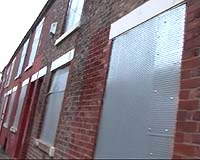
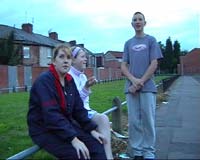
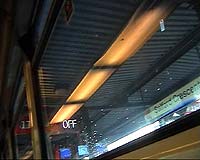
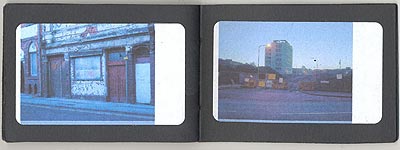
My production began with the intention of it being (whatever form "it" would take) the initial construction of a bridge between myself and an as yet unknown artist. Working under the presupposition that the "stranger" would be from another part of the country I used location, my locality as content. Communicating this environment, an integral part of my life, to someone else for viewing within the context of their own space, and area was my motivation. The intention was to provoke a response from the person, almost on a primitive territorial level challenging them to react with a representation or response of their own. A technique I have developed recently is to film from a plastic carrier bag. As I walk along the viewer perceives a jagged disjointed view of the world, mirroring the dilapidated dystopia of Salford. I filmed streets in the area that are due for regeneration, epitomising the hope and hopelessness that Salford currently balances between. During this process I met some local kids who were interested in what I was doing and convinced me to do an impromptu interview with them about the area. This actually turned out to be the most interesting part of my footage giving a human angle to the problems of en-mass re-housing and regeneration. I then proceeded to film a train journey concentrating on movement, travel and transience. This acted as a kind of closure to my half of the work, a backdrop and rehearsal for the journey I would later take to Doncaster, in this way the work pre-empted itself. I received two pieces back from Anna Pharoah, described in her [criticism] section of this site. I found it intriguing that she had connected to the work on a visual level as well as with issues that I focus on of territory and environment. The visual element of my work is often overlooked and denigrated by myself beneath conceptualism as I search for more and more answers to the many questions I have. As a visual artist this is obviously not ideal and has led me to consider how to integrate complex concepts with accessible and well communicated pieces. |