

| ||||||||
|
|
|
Coryat's Crudities: The Project 'As
a symbol the suitcase is double-edged, ambivalent in the extreme: on the
one hand, it evokes travel, displacement, emigration, exile and transience;
on the other, it is that part of home that travels with us, a reminder
of belonging and stability, the world of things we collect around us,
the promise of continuity in the midst of change, of order restored. The
suitcase is a portable heterotopia, an 'other space' that is always there
and here at the same time, a home away from home, but also offering the
endless possibility of new departures, whether desired or forced.' 'Coryat's Crudities' sought to extend Discotheque's travelogue treatise on tourism by using two heuristically packed, portable heterotopias* - suitcases - as sites for engagement. One, which looked back along the route thus far traversed, was to mirror Duchamp's travelling salesman archival swatch sample, Boîte-en-valise; the other more dynamic work in progress endeavoured to examine the intermedial possibilities at the intersection of the Hitman's rifle case, the Chinese puzzle box, the picnic hamper, and the souvenir fill-able spare capacity of the tourist's luggage - a Fluxus inspired empirical environment. |
|||
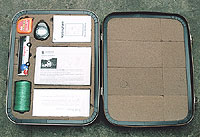 |
As part of 'NAN-NANA' - an artists' group networking event scheduled to coincide with Nottingham's hosting of the 'British Art Show 6' and the city's alternative art event 'Sideshow' - Discotheque embarked on a geo-conceptual mapping of Nottingham. The base for this part of the project was a suitcase containing the apparatus required for a series of city-wide experimental interventions and dialogues, which utilised both public space, Sideshow participating galleries and the numerous heterotopias in-between. |
||
* Foucault has it that the nineteenth-century museum is a heterotopia which serves to accumulate everything, to establish a general archive, "constituting a place of all times that is itself outside of time and inaccessible to its ravages . . . organizing in this way a sort of perpetual and indefinite accumulation of time in an immobile place". Foucault, 'Of Other Spaces' (1967), 'Heterotopias'. |
|||